



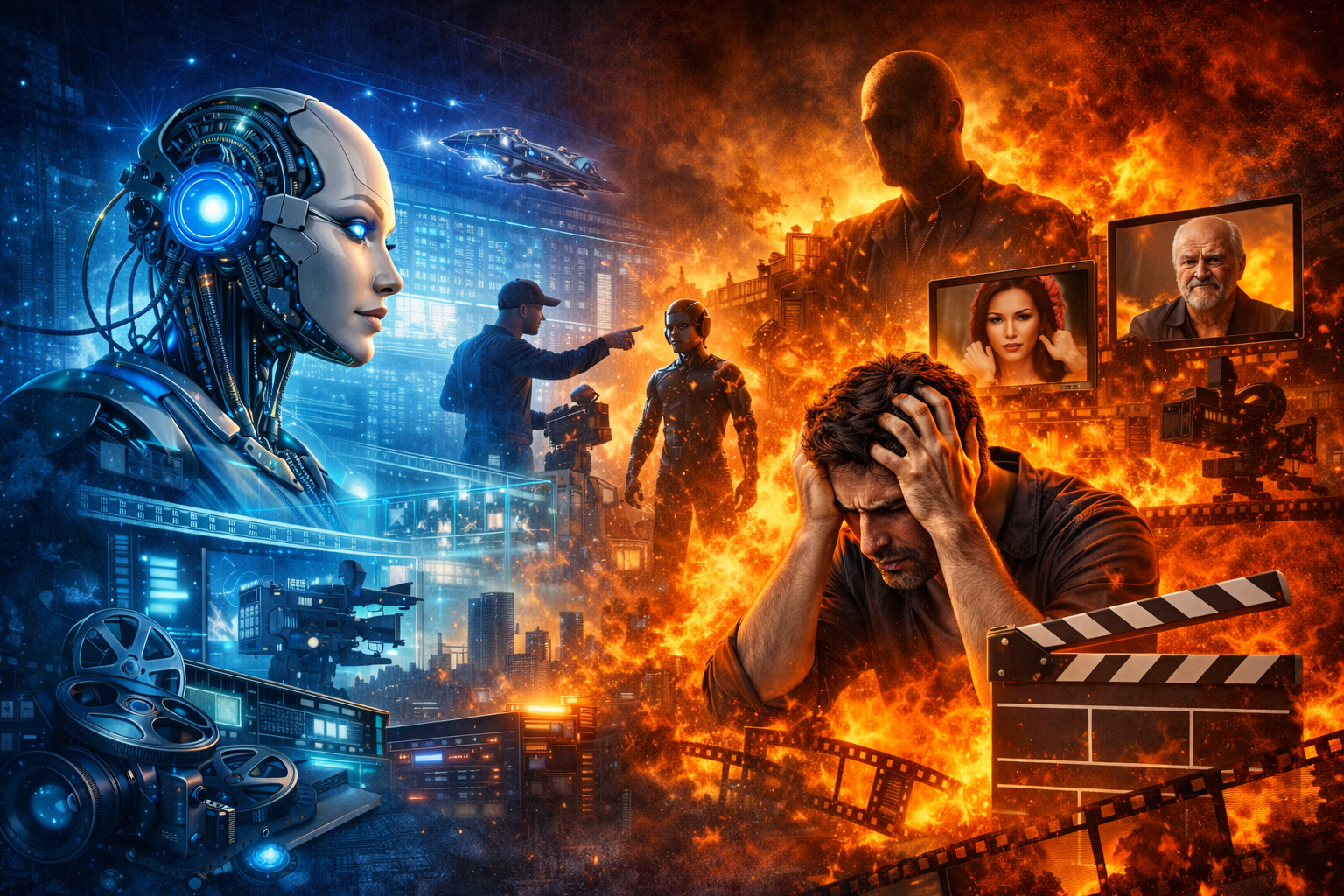
Cinema today is no longer just a storytelling medium—it has evolved into a powerful fusion of technology and art. At the heart of this transformation lies one of the most debated innovations of our time: Artificial Intelligence (AI). While AI is opening exciting new doors for filmmakers, it is also raising serious concerns about creativity, ethics, and the future of artists.
So, is AI truly a blessing for cinema, or is it a silent threat? The answer lies somewhere in between.
🎥 A Revolution in Visual Storytelling
There was a time when visual effects (VFX) required massive sets, huge budgets, and months of hard work. Today, AI has completely transformed that landscape.
From recreating realistic environments to bringing back younger versions—or even deceased actors—on screen, AI is pushing boundaries like never before. While this feels magical, it also raises important ethical questions:
- Is it right to recreate someone’s face without their consent?
- Is family approval enough to justify it?
These questions highlight the moral dilemmas hidden behind technological brilliance.
🎙️ The Value of Human Emotion
AI has also entered the world of voice and dubbing. Today, voices can be replicated and altered to match different languages or tones.
This helps producers save time and money—but at what cost?
Dubbing artists, who bring life and emotion to characters, are now facing uncertainty. Their craft risks being replaced by machines. This is not just about jobs—it’s about the gradual loss of human emotion in art.
✍️ Can AI Truly Write Stories?
AI is now being used to generate scripts and story ideas. While it can produce fresh concepts quickly, there’s a deeper concern:
Can AI truly understand human emotions?
A story is more than a sequence of events. It reflects pain, joy, struggle, and lived experiences. These are deeply human elements. While AI can imitate structure, capturing the soul of storytelling remains a challenge.
This raises fears about the diminishing importance of writers in the creative process.
🎬 Big Dreams, Smaller Budgets
One undeniable advantage of AI is how it empowers filmmakers—especially those with limited resources.
With AI and virtual production:
- Expensive locations can be digitally recreated
- Large-scale scenes can be produced on smaller budgets
- New filmmakers get more opportunities to bring their visions to life
In this sense, AI is truly a boon—democratizing cinema and making big dreams more accessible.
⚠️ The Missing Human Touch
Despite all its advancements, AI often lacks one crucial element: soul.
Cinema is powerful because it connects emotionally with the audience. Even the most visually stunning AI-generated scenes can sometimes feel artificial or empty.
Audiences don’t just watch films—they feel them. And that emotional connection is something AI still struggles to replicate.
🎭 Impact on the Kannada Film Industry
AI is gradually entering regional industries like Kannada cinema as well.
It is already being used for:
- Poster design
- Trailer editing
- Promotional content
While this supports new talent and reduces costs, it also raises concerns about overdependence on technology. Creativity, after all, is born from human imagination—not algorithms.
🚨 The Rise of Deepfakes and Misinformation
One of the most serious threats of AI is the rise of deepfake content.
AI can now:
- Create fake videos of actors
- Spread misleading scenes before a film’s release
- Manipulate public perception
This affects the credibility of the film industry and confuses audiences, making it harder to distinguish between real and fake.
🧠 The Ultimate Question: Who Controls Whom?
Will AI eventually take over cinema entirely?
Could machines write scripts, create visuals, and even act?
While this idea may seem unsettling, one truth remains clear:
AI is a tool—not a replacement for human creativity.
It can assist, enhance, and accelerate—but it cannot feel.
⚖️ Final Verdict: A Balanced Perspective
AI is neither entirely a boon nor a curse. Its impact depends on how we choose to use it.
- Used wisely, it can unlock new creative possibilities
- Used excessively, it can dilute the essence of art
The responsibility lies with us.
❤️ Conclusion: Cinema Still Belongs to Humans
AI can amplify our dreams—but it cannot give them life.
True art comes from the heart, from lived experiences, from human emotions. While AI may shape the future of cinema, it will never replace the human spirit behind it.
So, instead of fearing AI, we must learn to control it, balance it, and use it responsibly—before the tool we created begins to control us
